Friday, March 6, 2009

Wangaratta’s buffer from crisis

New strategy to keep our economy ticking

Written by STEVEN BURKE. - Source: Wangaratta Chronicle

THE Federal Government is pumping billions of dollars into the economy to avoid a recession, and now Wangaratta is coming up with its own response to the world economic crisis.

The board of Wangaratta Unlimited has devised a draft strategy to try to minimise the effects of an economic downturn on the local economy.

And while full details of the strategy are still under wraps, Wangaratta Unlimited’s Graham Nickless said the board was pulling out all stops to help keep the local economy ticking over.

He said current projects, like Goulburn Ovens TAFE’s Technical Education Centre, the development of the Ovens Riverside Precinct and the impending arrival of Bunnings hold the rural city in good stead, but it was important to capitalise on major projects.

"We are trying to build some sort of buffer for the local economy," he said.

"In no way do we think we are insulated from what is going on in the world.

"The effects will cascade down.

"But we are trying to be on the front foot."

One of the ideas touted in the strategy will be a mentoring program, involving board members of Wangaratta Unlimited.

"It’s a time for leadership," Mr Nickless said.

"They are looking at roles they may be able to play with smaller businesses."

He said the strategy would focus on opportunities.

"Interest rates are the lowest they’ve been for decades," he said.

"Now is not the time to be timid."


Labels: ,

Tuesday, February 3, 2009

Australian Prime Minister calls for New World Order

Gais,
Switzerland
A Daily Compendium
of Free-Market Analysis

Appenzer Daily Bell • Issue 198 • Tuesday, February 03, 2009

"It is easy to understand why the law is used by the legislator to destroy in varying degrees among the rest of the people, their personal independence by slavery, their liberty by oppression, and their property by plunder.." - Frederick Bastiat

Australian PM calls for New World Order


Getty Images

Kevin Rudd has denounced the unfettered capitalism of the past three decades and called for a new era of "social capitalism" in which government intervention and regulation feature heavily. In an essay to be published next week, the Prime Minister is scathing of the neo-liberals who began refashioning the market system in the 1970s, and ultimately brought about the global financial crisis. "The time has come, off the back of the current crisis, to proclaim that the great neo-liberal experiment of the past 30 years has failed, that the emperor has no clothes," he writes of those who placed their faith in the corrective powers of the market. - Sydney Morning Herald

Dominant Social Theme: New Labour will have its day.

Free-Market Analysis: So who is Kevin Rudd? He is a center left politician and Prime Minister of Australia, a country that does not quite have the clout of Britain within the Anglo-Saxon sphere of influence, but which is nonetheless a dynamic and important adjunct. Here is a little of what Wikipedia has to say:

Kevin Michael Rudd (born 21 September 1957) is the 26th and current Prime Minister of Australia and federal leader of the centre-left Australian Labor Party (ALP). Under Rudd's leadership, the Labor Party won the 2007 federal election on 24 November against the incumbent centre-right Liberal/National coalition government led by John Howard (see Howard Government). The Rudd Ministry was sworn in by the Governor-General, Michael Jeffery, on 3 December 2007.

The SMH article, excerpted above, in its entirety is filled with one odd factoid after another. But we find it interesting because we've been waiting for a statement about how the center-left leaders that run most of the world's Western governments these days are going to deal with the financial crisis. After all, as one of American President Barack Obama's top aides reportedly put it, "A crisis is a terrible thing to waste."

By reading a variety of tea leaves we have come to expect that suggestions for a new financial order will be rolled out by the suddenly authoritative G20 (group or gang - whatever - of 20 industrial nations) that was supposed to have a meeting in February. Now the next big meeting is supposedly set for April. But we think Kevin Rudd has given us a taste of what is to come. And, yes, we expected it because the gentlemen involved (mostly male, anyway) will want to float a variety of trial balloons in advance of any authoritative statements. British Prime Minister Gordon Brown did so recently at Davos - along with Angela Merkel and others - though his presentation was marred by the ring, several times, of his own cell-phone. An omen?

Anyway, Brown was a bit vague and Rudd seems a tad more specific. But the arguments he makes are truly political ones, in that they do not seem grounded so much in the facts as in polemics. Here's some more of what he had to say, courtesy of the Sydney Herald:

He argues that "minor tweakings of long-established orthodoxies will not do" and advocates a new system that reaches beyond the 70-year-old interventionist principles of John Maynard Keynes. "A system of open markets, unambiguously regulated by an activist state, and one in which the state intervenes to reduce the greater inequalities that competitive markets will inevitably generate," he writes. He urges "a new contract for the future that eschews the extremism of both the left and right". He mocks neo-liberals "who now find themselves tied in ideological knots in being forced to rely on the state they fundamentally despise to save financial markets from collapse".

He advocates tighter regulation and policing of global finances, and identifies the immediate challenge as restoring global growth by 3 per cent of gross domestic product, the amount it is expected to fall in 2009. Next week, as Parliament resumes, his Government will chip in with a second economic stimulus package. Mr Rudd commits to keeping budgets in surplus "over the cycle", meaning deficits should be temporary. In a further sign the Government is not contemplating additional tax cuts, which would deliver a permanent hit to revenue, he stresses that stimulus measures have to be paid for when the economy recovers.

Mr. Rudd singles out Thatcherism as a culprit, as well as the former Howard government. His essay implicitly attacks the Opposition Leader, Malcolm Turnbull, who this week urged the free market be allowed to dictate commercial property values as he slammed a Government measure to prop them up. Mr. Rudd's essay follows the blast Mr. Obama gave Wall Street bankers yesterday for awarding themselves $28 billion in bonuses last year at the same time as they were being bailed out by taxpayers. In a message to Mr. Obama and the US Congress, Mr. Rudd counseled against erecting trade barriers. "Soft or hard, protectionism is a sure-fire way of turning recession into depression as it exacerbates the collapse in global demand."

So there it is in one package. Rudd and those with his point of view - and that would seem to include many of the world's leaders including those in Russia and China - believe that more regulation is certainly necessary and that government has a vital role to play not only in stabilizing economies but also in reducing "inequalities" that the market inevitably generates.

But Rudd makes arguments in our opinion that are straw men, easy to erect and easy to knock down. The main problem is Rudd identifies the enemy as neo-conservatives and politicians like Margaret Thatcher. In fact, American neo-cons are in favor of an activist military, an activist federal government of great power and do not seek change in central banking or the expanding, global financial system. Margaret Thatcher, like Ronald Reagan, did much to disenfranchise the worst of the Western welfare state, but had nothing to say when it came to the world's banking monopoly.

Rudd would have us believe that it is market capitalism that has brought us to this place. In fact, it is the money press of central banking that inflated the markets of the Western world over decades. The collapse has been sudden, but fiat money collapses usually are. The solutions that Rudd and others are suggesting have little or nothing to do with the problem. They are answers to difficulties that do not exist.

Conclusion: Rudd, Brown - and soon the entire G20 - will eventually issue a call to arms that will require a good deal more government involvement in Western financial affairs. There has even been talk of setting up a United Nations' financial office to oversee new regulations (see other article).

Once upon a time, a 20th century Bretton Woods agreement placed the world on a quasi-gold standard and crowned the dollar as the global currency reserve. This new-style Bretton Woods will call perhaps for a diminished dollar reserve currency and much expanded regulatory powers for national and international financial agencies. Since these solutions have absolutely nothing to do with the real problem, which is central banking money stimulation, it is a fair to ask why such measures are being advanced. Also: whom do they benefit?

Labels: , , , , ,

Monday, February 2, 2009

No signs of global crisis in Australia

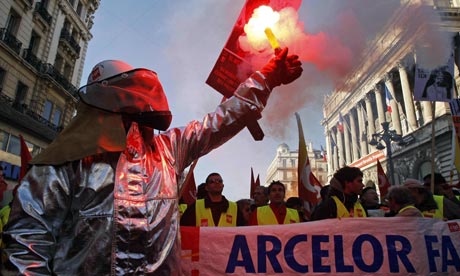
Governments across Europe tremble as angry people take to the streets

In pictures: credit crunch protests in Europe

France's trade-unions call on workers to strike all over the country

Arcellor Mittal workers demonstrate during a protest march in Marseille. Photograph: Jean-paul Pelissier/Reuters

France paralysed by a wave of strike action, the boulevards of Paris resembling a debris-strewn battlefield. The Hungarian currency sinks to its lowest level ever against the euro, as the unemployment figure rises. Greek farmers block the road into Bulgaria in protest at low prices for their produce. New figures from the biggest bank in the Baltic show that the three post-Soviet states there face the biggest recessions in Europe.

It's a snapshot of a single day – yesterday – in a Europe sinking into the bleakest of times. But while the outlook may be dark in the big wealthy democracies of western Europe, it is in the young, poor, vulnerable states of central and eastern Europe that the trauma of crash, slump and meltdown looks graver. ...more

Mediators called in as wildcat strikes spread across UK
The government called in mediators from Acas last night in an urgent attempt to end the dispute over the exclusion of British workers from construction contracts which led to a wave of wildcat strikes across the country yesterday. ... more

Greg's Comment:

Here, in Australia, there are no really visible signs of the global crisis.

  • So, we have all lost money in superannuation or shares - well at least on paper.
  • Those of us retiring right now have taken a hit but it is only in the order of 10% and there is the safety net of the age pension.
  • Few of us know people who have lost their homes and, in fact, with interest rates tumbling, many may feel better off.
It seems our systems of financial governance, since the dollar was floated by Paul Keeting, have indeed placed us in a better position than most other countries.

Labels: , ,

Wednesday, January 28, 2009

Real Labor would create a people’s bank, not a “Rudd Bank”

Media Release 27th of January 2009

Craig Isherwood‚ National Secretary
PO Box 376‚ COBURG‚ VIC 3058
Phone: 03 9354 0544 Fax: 03 9354 0166
Email: cec@cecaust.com.au
Website: http://www.cecaust.com.au

Citizens Electoral Council leader Craig Isherwood has slammed Kevin Rudd’s proposal to make the Government the “lender of last resort” to Australian corporations, which this year face $75 billion worth of foreign loans falling due that they can’t repay.

“Australia desperately needs a new national bank, another ‘people’s bank’ like the original Commonwealth Bank,” Mr Isherwood declared, “It is what a real Labor Party government would do.

“This so-called Rudd Bank proposal is a continuation of the globalist policies adopted by Labor under Hawke and Keating, which systematically handed the public resources that old Labor had built up for decades, over to private financial interests.

“Now that those private interests are going broke, another Labor government is planning to step in with more public resources, and bail them out.”

NAB and Westpac have led Australia’s banks in lobbying Canberra for the “Rudd Bank” scheme, in which the Government would put up the lion’s share of a fund, raised through the sale of government bonds, which would be leveraged up to as much as $30 billion, and directed especially into the commercial property sector.

NAB chief Cameron Clyne told The Australian on Jan. 23, “I think this is the time when strong, functioning [sic], major banks look at partnership opportunities with the Government on a whole range of issues.” [Emphasis added]

Mr Isherwood continued: “It is time to come clean—in truth, our banks are busted, and the Government plans to bail them out.

“Prime Minister Rudd should heed my call last week for an Australian Pecora Commission, to investigate corruption and possible criminality in the financial system, especially the interface between private finance and the politicians who pass the policies to facilitate their corrupt practices.

“He should also return to real Labor values, and establish a new national bank, not to bail out corporates, but to direct public credit into an economic recovery program, centred on large-scale water, power and transport infrastructure projects that would both provide the basic economic infrastructure our industrial economy needs, and create millions of jobs, for those people who are losing their jobs every day as whole sectors of the speculative economy shut down.

“The issue is private benefit vs. the public good,” Mr Isherwood concluded, “and Australia will only survive this crisis if the Government pursues the public good.”

Click here to watch Craig Isherwood’s half-hour video elaborating his call for an Australian Pecora Commission, which gives background to Labor’s historical fight for a banking system in the public interest, and names the names of the rogues’ gallery of politicians who have destroyed our economy on behalf of private banks.

Labels: , , ,